Reduce Support Tickets With a Knowledge Base/Help Center

How to Actually Reduce Support Tickets With a Knowledge Base
Adding a knowledge base rarely cuts ticket volume on its own. Gartner found that even though 73% of customers use self-service at some point, only 14% fully resolve their issue there. The fix isn't more articles — it's making the KB retrievable (an AI can answer from it), discoverable (the answer appears where the question is asked), and honest about escalation (a clean handoff the moment it can't help).
Why "just add a knowledge base" underperforms
The standard advice — document your FAQs, publish a help center, watch tickets drop — is half-right. The publishing part is easy. The deflection part usually doesn't follow.
The data is blunt about this. In a Gartner consumer survey of roughly 5,728 customers, only 14% of service issues were fully resolved in self-service, and even for issues customers themselves described as "very simple," just 36% resolved without a human. Separately, Gartner found 53% of customers go straight to an agent — and only 20% of them because they didn't realize self-service existed. In other words, four out of five people skipping your KB are skipping it for reasons a bigger KB won't fix.
It's not that customers don't want self-service. Salesforce's research found 61% prefer self-service for simple issues. The appetite is there. The execution is what's missing — and it's a real differentiator: Salesforce also found that 80% of high-performing service organizations offer self-service, versus just 56% of low performers. The gap between those two numbers is the gap between a KB that deflects and one that just exists.
So the goal isn't "have a knowledge base." It's "have a knowledge base that resolves the question before a ticket is opened, and gets out of the way cleanly when it can't."
Which tickets a knowledge base can actually deflect
Not every ticket is deflectable, and pretending otherwise is how you build a wall instead of a help center.
The deflectable tickets share a profile: repetitive, low-judgment, and already answered somewhere in your product or docs. These are the password resets, billing and plan questions, "how do I do X" walkthroughs, account-setup steps, and the same three or four troubleshooting issues that recur every week. They're the bulk of inbound volume for most SaaS teams, and they're exactly what a well-built KB — or an AI reading from it — should close instantly, 24/7.
The tickets you should not try to force through self-service are the complex, ambiguous, high-stakes, or emotionally charged ones. A customer who's angry, blocked on a deadline, or describing a bug that spans three screens needs a human, and the fastest path to a human is the only acceptable answer.
A useful framing: self-service should win back your team's time on the routine majority of tickets so they can spend judgment on the cases that need it. That's also where the industry is heading — Gartner forecasts that by 2029, agentic AI will autonomously resolve 80% of common service issues, with around a 30% cut in operational costs. "Common" is the operative word.
The three jobs a deflecting KB has to do
If a knowledge base is going to actually reduce tickets, it has to do three separate jobs well. Most KBs do the first one and stop.
Discoverability is table stakes. Retrievability is the new bar in 2026 — your KB is no longer just something humans read; it's the retrieval source for the AI sitting in front of it. And escalation, covered below, is the one everybody underinvests in and customers feel the most.
Write articles for retrieval, not just reading
Here's the shift the generic advice misses: a knowledge base now has two readers. One is the customer skimming for an answer. The other is the AI agent retrieving a passage to answer on the customer's behalf. Write for only the first, and the second performs badly.
What changes when you write for retrieval too:
Answer first, in the first sentence. State the resolution before the context. This helps a skimming human and gives a retrieval system a clean, self-contained passage to pull. ("To rotate your API key, go to Settings → Authentication and click Rotate" beats three paragraphs of preamble.)
One article, one job. A single article that tries to cover billing and cancellation and refunds retrieves ambiguously. Split them. Tightly-scoped articles are easier for both a person and a vector search to match to a question.
Use the words your customers use, not your internal names. This is the highest-leverage edit. Real users don't search your feature names — they describe the problem. Pull the actual phrasing from your support inbox, from Reddit, and from review sites, and write headings to match. A genuine complaint like "the release notes look like a developer wrote them" is a better article title than "Changelog formatting configuration."
Spell out the implicit steps. The tacit knowledge your senior agents carry — the "oh, you also have to refresh" step — is exactly what's missing from articles and what makes an AI answer wrong. Document the full path, including the failure branches.
Put the answer where the question gets asked
A help center that lives at help.yourcompany.com is a destination the customer has to leave your product to reach. Every extra step between "I have a question" and "here's the answer" is a chance to give up and open a ticket instead.
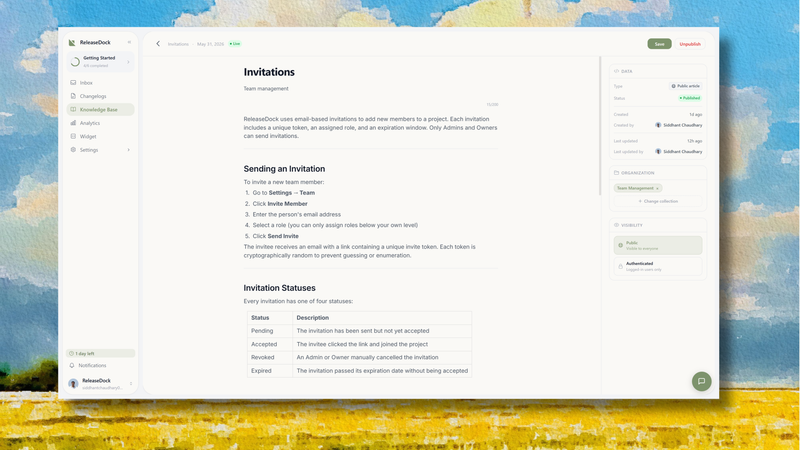
The deflection that works happens in context: an embedded widget inside your app where the customer can search the KB, read changelogs, and ask the AI agent without changing tabs. The closer the answer is to the moment of friction, the higher the deflection. This is also why a separate chatbot bolted onto a separate help site underperforms — the customer has already decided self-service is a chore.
The escalation problem almost nobody solves
This is the section the listicles skip, and it's the one customers care about most.
Go read how people actually talk about support bots. The recurring complaints aren't "there weren't enough articles." They're visceral: a bot that answers a question about one thing with information about something entirely different, then asks the customer to click "this resolved my issue." Or worse — the customer asks for a human, the bot promises a ticket, and then nothing happens. One user described trying three times over the same issue and getting "crickets." On a product feedback board, someone had to file a request asking for a simple "this is tricky for me — click here for a human" fallback. People are requesting graceful failure as a feature.
That tells you where to spend your effort. A deflecting KB isn't one that never fails — it's one that fails honestly and fast. The escalation path matters more than the deflection rate. Concretely, good escalation means:
The agent recognizes when it doesn't know (low retrieval confidence) and hands off instead of guessing.
The customer can demand a human at any point and get one immediately.
Sensitive topics — billing disputes, cancellations, anything with money or churn risk — skip the bot entirely and go to a person.
The handoff carries context: the human picks up with the full transcript of what the customer already tried, so they never have to start over.
Nail that, and customers tolerate — even appreciate — the AI layer, because it never traps them. Miss it, and you've built the self-service experience that's worse than offering none at all.
Measure deflection like you mean it
You can't improve what you measure badly, and "number of articles published" is a vanity metric. The metrics that actually tell you whether your KB is deflecting:
Deflection rate — how many customers viewed a relevant article before a conversation started (and didn't end up opening one). This requires linking article views to conversations, not counting them separately.
Resolution rate — of the conversations the AI did handle, how many actually resolved versus quietly got abandoned or reopened. A high "closed" count means nothing if customers are reopening.
Search-success rate — searches that led to an article view. A low rate points straight at a discoverability or wording gap.
High-view, low-helpfulness articles — the ones people read but rate unhelpful. These are your highest-ROI rewrites.
The thread tying these together is that your KB, your AI answers, and your support conversations have to live in one system. If article analytics sit in one tool and conversations in another, you can't see that an article was viewed right before a ticket — which is the single most important deflection signal you have.
How ReleaseDock approaches ticket deflection
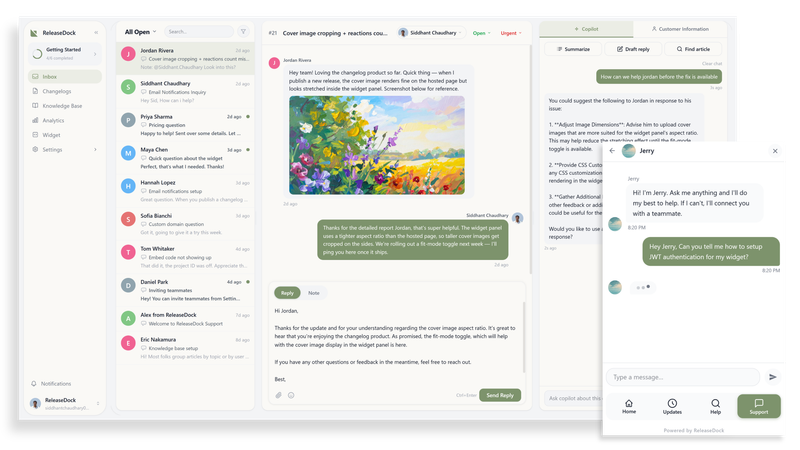
ReleaseDock bundles the knowledge base, AI support agent, live chat, and changelog into a single embeddable widget — one script tag, rendered inside a Shadow DOM so it can't collide with your app's styles. The point of the bundle is exactly the measurement problem above: the answer, the AI, and the conversation share one system, so deflection is actually traceable.
A few specifics from how it's built, since the escalation point above is where most tools fall down:
The AI answers from your KB, not from the open internet. A customer question is embedded and run through a vector similarity search against your published articles and changelogs, with the last several turns of conversation as context. It answers from your content or it doesn't answer — no hallucinated policies.
A five-trigger escalation ladder, in priority order. The agent hands off to a human when the customer explicitly asks, when the question hits a sensitive keyword you've defined (billing, cancel, refund), when retrieval comes back empty, when the model's own confidence is low, or when the conversation passes a turn limit you set. You can tune the retrieval similarity threshold (0.5–0.95) to trade coverage against precision.
Escalation carries the full transcript. When the AI hands off, it opens a real support conversation with the entire AI exchange attached, so the human starts with everything the customer already tried — no "can you describe your issue again?"
Resolution is tracked honestly. A conversation counts as resolved when the customer confirms it helped, or after 24 hours of silence — and if they reply again on a "resolved" thread, it flips back to active and the resolution count is decremented. The number reflects reality.
Deflection is measurable. Article views in the widget are linked to the conversation and contact, so the analytics show how many people read an article before (or instead of) opening a ticket.
The honest trade-off: ReleaseDock is built for product-led SaaS teams who want self-service, support, and product updates in one place. If you need a heavyweight enterprise help desk with deep CRM workflows, a legacy platform will fit better. For a team that wants tickets to drop without customers feeling walled off from a human, the integrated approach is the point.
The short version
A knowledge base reduces tickets only when it's built for the way customers actually behave: they'll use self-service if it's instant and in-context, and they'll forgive an AI that doesn't know the answer — as long as it gets them to a human without a fight. Publish for retrieval, surface answers in the product, and obsess over escalation. The deflection follows.
If you want the KB, AI agent, and changelog in one widget — with the deflection and resolution analytics to prove it's working — ReleaseDock includes 250 AI conversations a month and you can have it live with a single script tag. Try it on your own help content and watch where the answers land.
Key takeaways
Most self-service doesn't fail because the KB is missing — it fails because customers can't find or can't use what's there. Only 14% of issues fully resolve in self-service (Gartner).
The deflectable tickets are the repetitive ones: how-tos, billing, account setup, common troubleshooting. Complex and urgent issues should still reach a human fast.
A modern KB has to serve two readers: the customer scanning it, and the AI agent retrieving from it. Articles written only for human eyes retrieve badly.
The single biggest cause of self-service rage isn't a thin KB — it's a bot that gives an off-topic answer and then can't escalate. Solve escalation first.
Measure deflection honestly: track article views before a conversation starts, and whether the conversation actually resolved — not just how many articles you published.